




The choice of body cleanser is one of the most consequential and most overlooked decisions in a body care routine. Most people choose a body wash or soap based on fragrance or packaging and apply it daily to the largest organ of their body without considering what the surfactant system inside it is doing to their skin barrier with every use.
For dry skin specifically, the body cleanser is not a neutral step. The wrong cleanser actively worsens dry skin by stripping the barrier lipids that dry skin is already deficient in, triggering compensatory sebum production that never fully compensates for the structural barrier loss. The right cleanser nourishes as it cleans, leaving the barrier intact and the skin measurably better hydrated after each wash than before it.
Goat milk and honey have been used in Ayurvedic and classical beauty traditions for skin nourishment across centuries — not because of cultural convention but because both ingredients contain specific compounds that address the exact deficiencies of dry skin at the biological level. Understanding what those compounds are tells you exactly why a goat milk and honey formulation is the correct body cleanser for dry skin and why the skin responds to it differently from conventional soap or body wash.
|
“The right body cleanser for dry skin does not just clean the skin. It repairs and nourishes it simultaneously. For dry skin, every wash should be a nourishing step, not a depleting one.” |
Why Dry Skin Needs a Different Cleanser
Dry skin is a skin barrier problem. The skin's outermost layer — the stratum corneum — is a complex structure of corneocytes embedded in a lipid matrix of ceramides, fatty acids and cholesterol. This lipid matrix is the moisture barrier: it slows transepidermal water loss and prevents irritants and allergens from entering the deeper skin layers. In dry skin, this lipid matrix is compromised — it has either insufficient lipid content, disrupted lipid organisation or both. The result is skin that loses moisture faster than normal, feels tight and rough, and reacts more readily to environmental irritants.
Conventional soap and many body washes use anionic surfactants — sodium lauryl sulphate, sodium soap salts — that are highly effective at removing dirt, sebum and impurities but equally effective at removing the ceramides and fatty acids that make up the skin barrier. For dry skin, which is already barrier-compromised, this daily stripping is the single most consistent driver of worsening dryness. The skin loses moisture faster after washing than before it, regardless of how much body lotion is applied afterward.
A body cleanser formulated for dry skin must therefore meet a different specification than a cleanser for normal or oily skin. It must clean effectively without disrupting the lipid barrier. And ideally, it should contribute nourishing compounds that actively support barrier repair during the wash process itself. Goat milk and honey together do exactly this.
What Goat Milk Does for Skin
Lactic Acid — The Gentle Exfoliant
Goat milk contains a naturally occurring concentration of lactic acid — an alpha hydroxy acid. Lactic acid is the mildest of the AHA family and the one with the best documented safety profile for sensitive and dry skin. Its primary mechanism for skin is chemical exfoliation — it gently dissolves the bonds between dead skin cells on the surface, allowing them to shed without the mechanical abrasion of physical scrubs.
For dry skin, this gentle exfoliation is particularly valuable because dead cell accumulation is more visible on dry skin than on any other type — the rough, flaky texture that makes dry skin look dull and feel rough is largely dead cell buildup that regular soap does not remove effectively. Goat milk's lactic acid removes this accumulation gently and consistently with every wash, revealing the fresher, more nourished skin beneath.
Lactic acid also has documented humectant properties — it attracts and binds moisture to the skin surface. The same acid that exfoliates the surface also hydrates it, which is the combination that makes goat milk uniquely appropriate for dry skin compared to stronger AHAs like glycolic acid that exfoliate effectively but can over-dry sensitive skin.
Natural Fats and Proteins — The Nourishing Lipids
Goat milk's fat composition is closer to human skin's own sebum composition than almost any other animal milk. Its medium-chain fatty acids — caprylic, capric and caproic acid — penetrate the skin barrier more easily than the longer-chain fats in cow's milk, delivering lipid nourishment directly into the barrier structure during the contact time of the wash.
The proteins in goat milk provide an additional skin benefit during washing — they form a temporary film on the skin surface that reduces moisture loss during the rinse and dry phase immediately after bathing. This film is not heavy or occlusive. It is thin enough to be invisible and light enough to feel comfortable but substantial enough to slow the transepidermal water loss that typically occurs in the minutes after stepping out of the shower.
pH Compatibility
Goat milk has a naturally slightly acidic pH of approximately 6.7 to 6.8 — significantly closer to human skin's natural pH of 4.5 to 5.5 than the alkaline pH of traditional soap bars, which typically range from 9 to 10. High-pH cleansers disrupt the acid mantle — the slightly acidic film on the skin surface that protects against bacteria, fungi and environmental damage. For dry skin, which already has a compromised acid mantle, a lower-pH cleansing system that does not further disrupt this protective layer is a meaningful advantage.
What Honey Does for Skin
Humectant Hydration
Honey is one of nature's most effective humectants — it draws moisture from the surrounding environment to the skin surface and holds it there. This hygroscopic property means that honey applied to the skin does not just add surface moisture temporarily but actively pulls moisture to the skin and retains it. For dry skin that struggles to maintain adequate hydration, the humectant action of honey in a body cleanser provides a hydration contribution during washing that most cleansers do not provide.
Antimicrobial and Anti-Inflammatory Action
Raw honey contains hydrogen peroxide, methylglyoxal and defensin-1 — compounds with documented broad-spectrum antimicrobial activity. For body skin exposed to sweat, bacteria and environmental pollution daily, the antimicrobial action of honey in a body cleanser keeps the skin surface cleaner between washes and reduces the bacterial load that contributes to body odour and skin irritation.
Honey's anti-inflammatory compounds — including flavonoids and phenolic acids — reduce the surface skin inflammation that heat, sweat and friction cause in skin that is dry and therefore more reactive than well-moisturised skin. For people with dry body skin that becomes red and irritated in summer from sweat and heat, the anti-inflammatory action of honey in the daily wash routine provides meaningful symptomatic relief.
Wound Healing Support
Honey has one of the most extensively documented wound-healing records in both traditional and modern medicine. For body skin that cracks at the heels, knuckles or elbows — the areas where dry skin is most severe and most prone to micro-fissures — consistent washing with a honey-formulated cleanser supports the skin's natural repair process at these vulnerable areas with every wash.
The Syndet Bar Distinction
SADHEV Goat Milk and Honey Bathing Bar is a syndet bar — a synthetic detergent bar rather than a traditional soap bar. This distinction matters significantly for dry skin.
Traditional soap bars are made through saponification — the reaction of fats or oils with a strong alkali, typically sodium hydroxide. The resulting soap salts are effective cleansers but produce a pH of 9 to 10 and strip the skin barrier aggressively. The characteristic tight, dry feeling after washing with traditional soap is the barrier disruption this alkaline pH produces.
A syndet bar uses a synthetic surfactant system — in this case a mild, skin-compatible system rather than soap salts — formulated at a pH of 5 to 6.5. It produces lather, cleanses effectively and rinses cleanly, but without the alkaline pH that causes the barrier disruption. For dry skin, the shift from traditional soap to a syndet bar is often the single most immediately noticeable body care improvement — the post-wash tightness disappears, the skin feels comfortable rather than stripped and body lotion absorbs faster and more effectively because it is being applied to an intact barrier rather than a stripped one.
|
Format |
Syndet bar — not traditional soap |
|
pH |
5.0 to 6.5 — close to skin's natural slightly acidic pH |
|
Primary skin type |
Dry skin — also suitable for sensitive and normal skin |
|
Key ingredients |
Goat milk (lactic acid, natural fats), raw honey (humectant, antimicrobial) |
|
Ayurvedic principle |
Snehana — deep lipid nourishment to counteract Vata dryness |
|
Use frequency |
Daily — morning or evening shower |
|
Season |
Year-round for dry skin — particularly appropriate in winter and air-conditioning |
The Ayurvedic Context — Snehana for Body Skin
Classical Ayurveda classifies dry skin as a Vata condition. Vata is dry, light, cold and mobile — the qualities that manifest as the tight, rough, flaky skin of Vata imbalance. The Ayurvedic treatment principle is Snehana — the application of oils and fats to counteract Vata's depleting qualities and restore moisture and suppleness to the skin tissue.
Goat milk's natural fat composition is exactly the kind of Sneha — lipid nourishment — that classical Ayurveda prescribes for Vata skin conditions. Applied as a cleanser rather than a leave-on treatment, it delivers its nourishing fats to the body skin during the wash process and leaves a trace of lipid nourishment on the skin surface that supports barrier function between washes. Honey's humectant action complements this by drawing moisture to the skin surface that the goat milk fats then help retain.
This is the Ayurvedic formulation logic — ingredients chosen for their documented action on the specific dosha imbalance rather than for fragrance or marketing appeal. A cleanser built on Snehana principles for Vata skin produces a measurably different body skin outcome from a cleanser built on aggressive surfactant chemistry.
How to Use the SADHEV Goat Milk and Honey Bathing Bar
▸ Wet the skin thoroughly with warm water — not hot. Hot water dissolves skin lipids more aggressively than warm water and worsens dry skin regardless of the cleanser used. Warm water is the correct temperature for dry skin cleansing.
▸ Lather the bar between the palms or apply directly to the body. The lather is gentler than conventional soap lather — it feels different but cleans just as effectively through its milder surfactant chemistry.
▸ Apply in gentle circular motions across the body. The lactic acid in the goat milk provides mild exfoliation during this step — no separate body scrub is needed on daily wash days.
▸ Rinse thoroughly with warm water. The syndet formula rinses cleanly without the residue that some nourishing bars leave behind.
▸ Pat dry gently with a soft towel — never rub. Rubbing removes the thin protective film that goat milk proteins deposit on the skin during the wash.
▸ Apply SADHEV Herbal Body Lotion immediately on slightly damp skin — within 60 seconds of patting dry. Damp skin absorbs lotion significantly faster, the lotion goes further and the sustained hydration is measurably better than lotion applied to fully dry skin. This is the step that completes the cleanse-and-nourish cycle.
The Weekly Body Care Ritual for Dry Skin
The Goat Milk and Honey Bathing Bar is the daily body cleanser in the dry skin body care routine. For the twice-weekly exfoliation step that accelerates dead cell removal beyond what the daily lactic acid wash achieves, SADHEV Sea Salt Body Scrub applied before the bar in the shower provides the deeper exfoliation that reveals the fresher, more nourished skin the daily bar is working toward. Exfoliated skin absorbs body lotion more effectively than unexfoliated skin — the lotion reaches the fresh cells rather than sitting on top of accumulated dead cells.
The complete dry skin body routine:
▸ Daily: Warm shower — Goat Milk and Honey Bathing Bar — Herbal Body Lotion on slightly damp skin.
▸ Twice weekly: Sea Salt Body Scrub before the bar — then bar — then Herbal Body Lotion on damp skin. The exfoliation day produces the most visible improvement in skin texture and luminosity of any step in the routine.
Which Bathing Bar for Which Skin Type
SADHEV's bathing bar range is formulated with specific skin types in mind. The Goat Milk and Honey Bathing Bar is designed for dry skin. The Orange and Cinnamon Bathing Bar is formulated for oily skin — its astringent compounds regulate sebum without the stripping that conventional soap causes. The Sandal and Saffron Bathing Bar is formulated for combination skin — its anti-inflammatory and complexion-enhancing ingredients address the mixed concerns of combination body skin.
Using the correct variant for your skin type produces noticeably better results than using any variant regardless of skin type. The formulation philosophy is the same across all three — syndet base, Ayurvedic herbs, pH-balanced — but the active ingredient selection is specific to each skin type's needs.
The Realistic Timeline
▸ Days one to three: Reduced post-wash tightness immediately noticeable. The skin feels comfortable rather than stripped after bathing — the most immediate and consistent feedback from switching to a syndet bar from conventional soap.
▸ Weeks one to two: Improved skin texture as the daily lactic acid action gently removes accumulated dead cells and the body lotion applied afterward begins to absorb more effectively into better-prepared skin.
▸ Weeks three to six: Measurably more hydrated body skin as the intact barrier retains moisture more effectively between washes. Body lotion lasts longer through the day because it is being sealed by an intact barrier rather than evaporating through a compromised one.
▸ Months two to three: Fundamentally better body skin condition. Dry patches at elbows, knees and shins — the areas where dry skin is typically most severe — are visibly smoother and better nourished. The chronic dryness cycle driven by stripping cleansers has been completely broken.
For the complete Ayurvedic body care routine including the correct sequence for cleansing, exfoliation and moisturisation and how the Goat Milk and Honey Bathing Bar fits into the full body care protocol: see our complete SADHEV ritual guide.
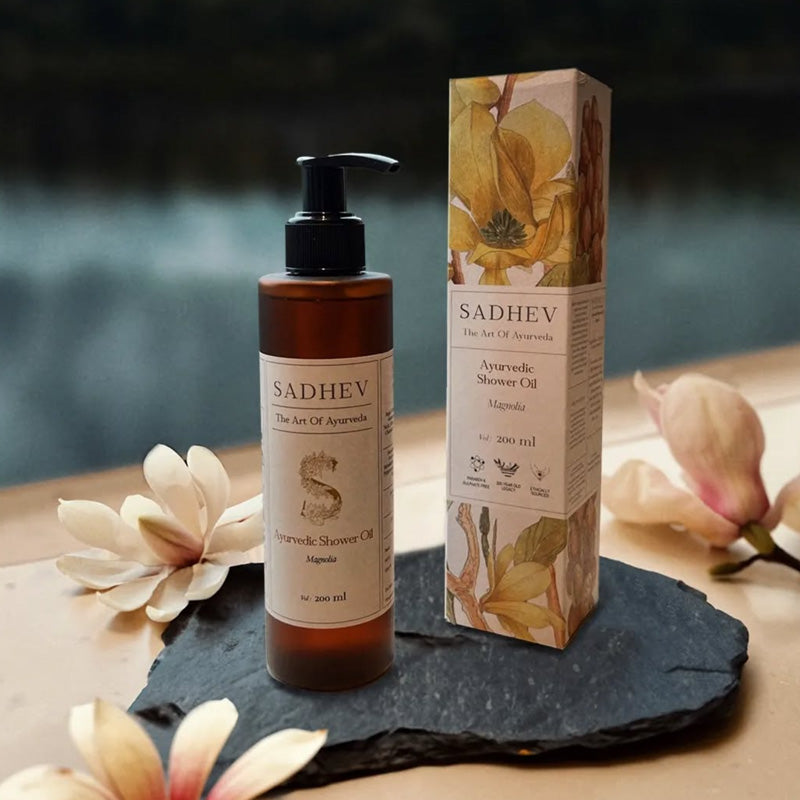
For the complete guide to the SADHEV Coconut Shower Oil — the oil-based body cleanser for sensitive and winter skin that uses emulsification rather than surfactant chemistry: see our shower oil vs body wash guide.
SADHEV. Luxury Ayurvedic Care. Ayurveda in our bloodline.
Experience SADHEV Goat Milk and Honey Bathing Bar — Ayurvedic body cleansing for dry skin.
— Written by SADHEV Ayurvedic Experts, rooted in a 200-year vaidyar lineage.


