




In classical Ayurveda, the title Kesharaj — king of the hair — belongs to a single herb. Bhringraj. Not amla. Not brahmi. Not neem. Bhringraj.
This is not a modern marketing designation. It appears in classical Ayurvedic texts including the Charaka Samhita and Sushruta Samhita, where bhringraj is documented as the primary Ayurvedic herb for hair health — its actions on the scalp, the follicle and the hair shaft more comprehensively documented than any other herb in the classical hair care pharmacopoeia.
Thousands of years of consistent use across generations of vaidyar practitioners do not simply reflect cultural tradition. They reflect observed efficacy — the accumulated clinical evidence of practitioners who had no incentive to recommend an ingredient that did not work and every incentive to find the ones that did.
Bhringraj works. Here is why.
|
“Bhringraj is not one of many Ayurvedic remedies for hair fall. It is the primary one — the herb around which classical hair care formulation is built.” |
What Bhringraj Is
Bhringraj is the common name for Eclipta alba — a small herbaceous plant that grows widely across India, particularly in moist, tropical regions. It produces small white flowers and has been cultivated for medicinal use in Ayurveda for thousands of years. The name bhringraj derives from Sanskrit: bhringa meaning bee and raja meaning king, a reference to the plant’s association with attracting bees and to its regal status in the Ayurvedic pharmacopoeia.
Every part of the plant has documented medicinal applications, but it is the leaf extract that carries the properties most relevant to hair and scalp health. The active compounds in bhringraj leaf include ecliptine, wedelolactone, various flavonoids and a range of phytosterols and polypeptides that work through specific biological mechanisms on the scalp and hair follicle.
Classical Ayurvedic texts describe bhringraj as having the qualities of being Keshya — beneficial to hair — along with Rasayana properties, meaning it supports tissue regeneration and restoration. These are not vague descriptions. They are specific therapeutic classifications that guided how vaidyars used the herb in formulation for centuries.
What Bhringraj Does — The Specific Mechanisms
Stimulates the Scalp and Hair Follicles
The most clinically documented action of bhringraj on hair health is its ability to stimulate blood circulation in the scalp. Healthy hair follicles require a consistent supply of oxygen and nutrients delivered through the blood. When scalp circulation is poor — due to stress, nutritional deficiency, age or chronic tension — follicles receive less of what they need to produce strong, healthy hair, and the growth cycle is disrupted.
Bhringraj applied to the scalp — either in oil form through massage or in a rinse-off formulation — has been shown to improve microcirculation in the scalp. Better circulation means better-nourished follicles. Better-nourished follicles produce stronger hair and are less likely to enter the resting phase prematurely, which is the primary mechanism behind stress-related and nutritional hair fall.
This is the physiological explanation for something Ayurvedic vaidyars have documented for thousands of years: consistent use of bhringraj reduces hair fall and improves growth. The classical observation and the modern mechanism are consistent.
Extends the Hair Growth Cycle
Hair grows in cycles. The anagen phase is the active growth phase, during which the follicle produces new hair. The telogen phase is the resting phase, during which growth stops and the hair eventually sheds. Premature entry into the telogen phase — triggered by stress, hormonal changes, nutritional deficiency or scalp inflammation — is the most common cause of increased hair fall.
Research on bhringraj extract has demonstrated that it supports the prolongation of the anagen phase and delays the transition to telogen. In practice this means that with consistent use, more follicles are in active growth at any given time and fewer hairs are shed prematurely. The cumulative effect over several months of consistent use is a measurable increase in hair density and a reduction in daily shedding.
This is not an overnight result. Classical Ayurvedic texts are clear that bhringraj’s effects on hair fall are cumulative and require consistent use over months rather than weeks. The modern research confirms this timeline. Eight to twelve weeks of consistent use is the minimum period for meaningful assessment.
Nourishes and Strengthens the Hair Shaft
Beyond its action on the scalp and follicle, bhringraj has direct nutritive effects on the hair shaft. It is rich in iron, vitamin E, magnesium and vitamin D — a nutrient profile that supports keratin production, the protein that forms the structural basis of the hair shaft. Stronger keratin means stronger hair with greater resistance to breakage, split ends and mechanical damage from brushing and styling.
Bhringraj also has natural conditioning properties that coat the hair shaft, reducing friction between hairs and improving their overall texture and manageability. This is the reason classical Ayurvedic hair formulations using bhringraj produce not just less hair fall but visibly healthier, more lustrous hair with consistent use.
Supports Scalp Health and Reduces Inflammation
Many cases of hair fall are driven by underlying scalp inflammation — caused by dandruff, seborrhoea, contact dermatitis or simply the chronic low-grade irritation that synthetic surfactants in conventional shampoos can produce over time. Inflamed scalp tissue is inhospitable to healthy follicle function and is a significant contributor to hair fall that is often misidentified as genetic or hormonal.
Bhringraj has documented anti-inflammatory and antimicrobial properties that address scalp inflammation at its source. It soothes irritated scalp tissue, reduces conditions that contribute to dandruff and creates an environment in which follicles can function as they are designed to. This is particularly relevant for people whose hair fall is accompanied by scalp sensitivity, itching or flaking.
May Support Natural Pigmentation
Classical Ayurvedic texts document bhringraj’s use in formulations intended to delay premature greying. Modern research has begun to investigate the mechanisms behind this observation, with some studies suggesting that bhringraj compounds may support melanocyte activity in the hair follicle — the cells responsible for producing the pigment that gives hair its colour. The evidence here is less conclusive than for bhringraj’s hair fall actions and requires more research. But the classical documentation is consistent and longstanding, and it is worth noting as a potential benefit for those using bhringraj-based formulations over extended periods.
|
“The classical title Kesharaj — king of the hair — was not honorary. It was earned through thousands of years of observed efficacy across every dimension of hair health.” |
How SADHEV Uses Bhringraj
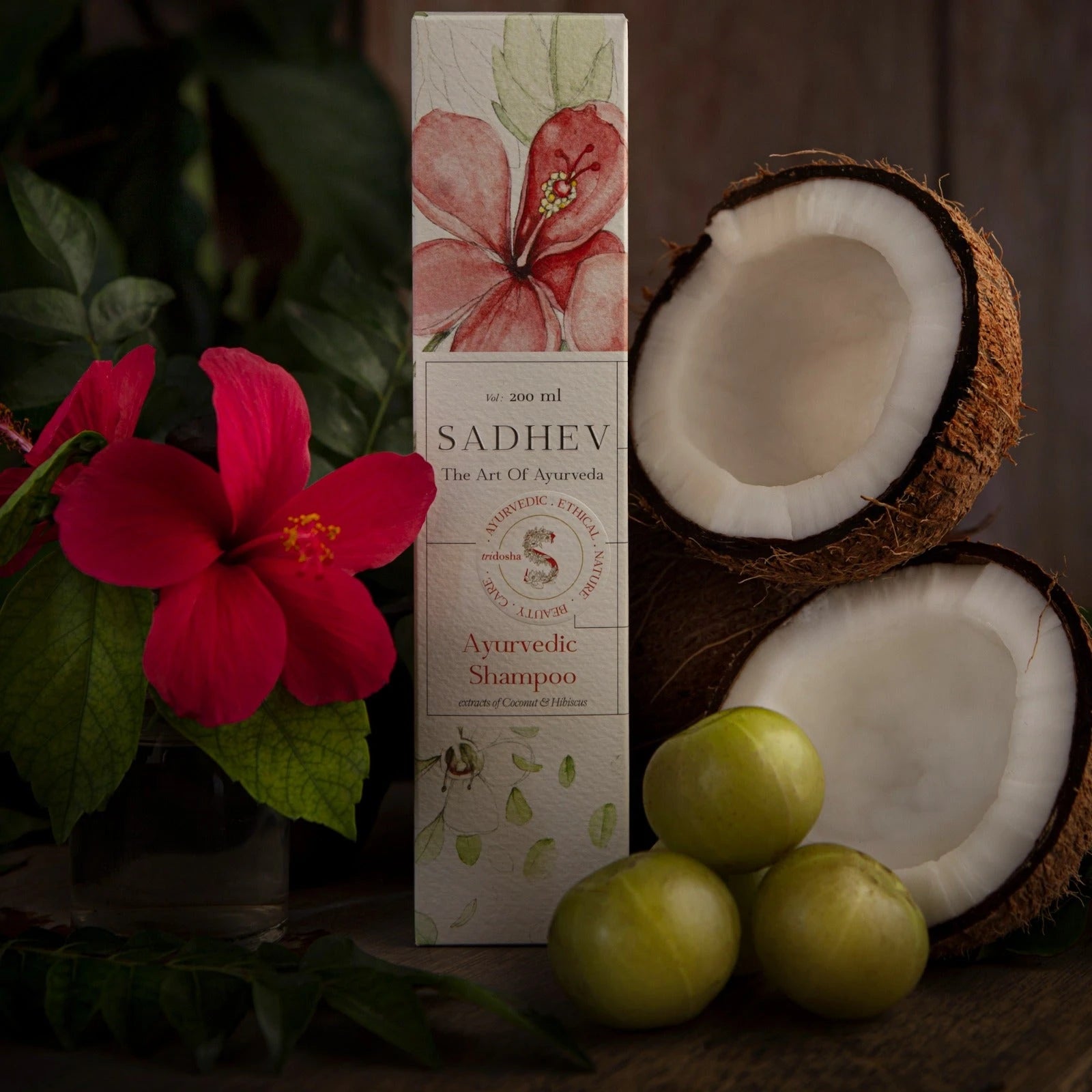
Bhringraj is a primary active in SADHEV’s Ayurvedic Shampoo — alongside amla, hibiscus, curry leaves and reetha in a sulphate-free formula designed to cleanse the scalp while actively delivering bhringraj’s therapeutic properties to the follicle with every wash.
The sulphate-free formulation is not incidental. Sulphates strip the scalp so aggressively that they counteract the very scalp health that bhringraj is working to establish. A bhringraj formulation in a sulphate-based shampoo is working against itself. SADHEV’s formula ensures that the cleansing action and the therapeutic action are aligned — the shampoo cleanses without disrupting, and the bhringraj does its work in a scalp environment that supports rather than undermines it.
The combination of bhringraj with amla — which boosts collagen levels and strengthens hair follicles — and hibiscus — which stimulates regrowth and prevents dryness — follows the classical Ayurvedic formulation logic of combining ingredients whose actions reinforce each other. This is not a marketing combination. It is how vaidyars have formulated for hair fall for centuries.
This formulation logic is rooted in a 200-year vaidyar lineage that informs every product SADHEV makes.
How Long Before You See Results
This is the most important expectation to set correctly. Bhringraj’s effects on hair fall are real, documented and consistent. They are not fast.
The hair growth cycle operates on a timeline of weeks and months. Changes to follicle health, scalp circulation and growth phase duration take time to manifest as visible changes in hair density and shedding levels. Classical Ayurvedic texts prescribe bhringraj-based formulations for sustained use over months, not weeks. Modern research confirms this — meaningful changes in hair fall and density are typically measurable at eight to twelve weeks of consistent daily use.
The consistent use is what matters. Using a bhringraj shampoo once a week for two weeks produces no meaningful result. Using it as the primary shampoo in a daily or regular hair care routine for three months produces the results that earned bhringraj its title in classical Ayurveda.
Give it the time the herb requires. The results compound. And unlike chemical hair fall treatments, they do not reverse when you stop — because bhringraj is restoring the health of the scalp itself rather than suppressing a symptom while the underlying condition continues.
For the complete step-by-step Ayurvedic hair care routine built around bhringraj and other classical hair herbs, see our full hair care routine guide
SADHEV. Luxury Ayurvedic Care. Ayurveda in our bloodline.
Experience bhringraj the way Ayurveda intended — in a sulphate-free formula built on 200 years of vaidyar knowledge.
— Written by SADHEV Ayurvedic Experts, rooted in a 200-year vaidyar lineage.


