




There are very few ingredients in Ayurveda’s pharmacopoeia that appear across both skin care and hair care formulations with equal authority. Amla is one of them.
Known in Sanskrit as Amalaki and in classical texts as one of the three fruits of Triphala, amla — the Indian gooseberry — has been central to Ayurvedic practice for thousands of years. It is classified as a Rasayana herb, meaning it supports tissue regeneration, longevity and the restoration of the body’s natural balance. In the specific context of skin and hair, this classification translates to a range of documented actions that make amla one of the most versatile and well-evidenced ingredients in classical Ayurvedic formulation.
The modern world has caught up. Amla is now widely recognised as one of the richest natural sources of Vitamin C on the planet — containing significantly higher concentrations than citrus fruits and in a form that is more bioavailable and more stable than synthetic ascorbic acid. This single fact explains much of what Ayurveda observed about amla’s effects on skin and hair thousands of years before the chemistry was understood.
Here is what amla actually does.
|
“Amla is classified in classical Ayurveda as Rasayana — a restorer of tissues and natural balance. For skin and hair, this is not a metaphor. It is a specific, documented set of actions.” |
What Amla Is — The Ayurvedic Classification
Amla appears in the Charaka Samhita and Sushruta Samhita as one of the most comprehensively documented herbs in the entire classical Ayurvedic pharmacopoeia. It is one of three fruits that compose Triphala — the foundational Ayurvedic formulation used across multiple therapeutic applications — alongside haritaki and bibhitaki.
In the classical Ayurvedic system, amla is described as possessing five of the six tastes — sour, sweet, bitter, pungent and astringent — which in Ayurvedic pharmacology indicates broad therapeutic applicability across multiple systems. Its actions are documented as Chakshushya (beneficial to the eyes), Keshya (beneficial to hair), Varnya (brightening to the complexion) and Rasayana (regenerative and restorative).
These are the same classification categories used for saffron and bhringraj. In classical Ayurveda, when an herb appears across multiple therapeutic categories with consistent, well-documented actions, it reflects generations of vaidyar observation that produced reliable results across different applications and different patients. Amla’s presence in both skin and hair formulations is not coincidence. It reflects a genuine dual-action that the classical system identified and documented with precision.
What Amla Does for Skin
Natural Vitamin C — The Brightest Form
Amla contains one of the highest concentrations of Vitamin C found in any natural source — significantly higher than oranges, lemons or any citrus fruit, and in a form that is considerably more stable than synthetic ascorbic acid. Synthetic Vitamin C oxidises rapidly on exposure to light and air, losing its potency before it can penetrate the skin effectively. The Vitamin C in amla is bound to tannins that protect it from oxidation, making it more stable in formulation and more bioavailable when applied to skin.
The skin benefits of this natural Vitamin C are the same as those that have made Vitamin C serums one of the most popular categories in modern skincare: brightening of uneven skin tone, reduction of dark spots and hyperpigmentation, stimulation of collagen synthesis and antioxidant protection against UV and environmental damage. Ayurveda documented these actions under the varnya and Rasayana classifications thousands of years before Vitamin C was identified as the mechanism.
Collagen Support and Anti-Ageing
Vitamin C is the essential cofactor in collagen synthesis — the process by which the skin produces the structural protein that gives it firmness, elasticity and resilience. Without adequate Vitamin C, collagen production declines and the skin loses the structural integrity that keeps it looking youthful. With consistent topical application of bioavailable Vitamin C, collagen synthesis is supported and the visible signs of ageing — fine lines, loss of firmness, sagging — develop more slowly.
This is the anti-ageing mechanism behind amla’s classical Rasayana classification as it applies to skin. The classical observation that amla supports tissue regeneration and delays the visible signs of ageing is a direct description of what we now understand as collagen synthesis support. The language is different. The action is the same.
Antioxidant Protection
Amla is rich in a range of antioxidant compounds beyond Vitamin C — including gallic acid, ellagic acid, quercetin and kaempferol — that protect skin cells from oxidative damage. Free radical damage from UV exposure, pollution and environmental stress is the primary driver of premature skin ageing. Amla’s antioxidant profile provides broad-spectrum protection against these stressors, complementing the UV protection provided by sunscreen with a cellular defence mechanism that works at the level of the skin cell itself.
Brightening and Pigmentation Control
Amla’s Vitamin C content inhibits tyrosinase — the enzyme that drives melanin overproduction in response to UV exposure, inflammation and hormonal changes — in the same way that saffron does, but through a different molecular mechanism. The two ingredients are frequently combined in Ayurvedic formulations precisely because their brightening actions are complementary and additive rather than redundant. Used together, as in SADHEV’s Vitamin C Serum which features both amla and Kakadu plum alongside other brightening actives, the pigmentation-controlling effect is greater than either ingredient achieves alone.
What Amla Does for Hair
Strengthens Hair Follicles and Reduces Hair Fall
Amla’s collagen-supporting action applies to hair as well as skin. The hair follicle is surrounded by a dermal papilla — a structure rich in collagen that anchors the follicle in the scalp and supports its function. When collagen in the scalp is depleted through nutritional deficiency, oxidative stress or ageing, follicles become less securely anchored and less efficient at producing strong hair. Amla’s support of collagen synthesis strengthens this structure and contributes to more secure, better-functioning follicles.
The essential fatty acids in amla nourish follicles directly, providing the lipid building blocks that healthy hair shaft production requires. The combined action of collagen support and direct follicular nourishment makes amla one of the most effective natural ingredients for reducing hair fall driven by nutritional deficiency or scalp health decline.
Promotes Hair Growth
Amla has been shown to stimulate hair growth through multiple mechanisms. It improves scalp circulation, extending the supply of nutrients to active follicles. It supports the anagen phase of the hair growth cycle — the active growth phase — helping more follicles remain in productive growth for longer. And its anti-inflammatory properties create a scalp environment that is more conducive to healthy follicle function.
Classical Ayurvedic texts document amla as one of the primary ingredients in formulations intended to promote hair growth and density. The classical observation aligns precisely with what the modern understanding of the mechanisms would predict.
Natural Conditioning and Lustre
Amla has natural conditioning properties that coat the hair shaft, smooth the cuticle and improve the hair’s natural lustre. This is the action most immediately visible when amla is used in a rinse-off formulation like a shampoo or conditioner — the hair emerges from the wash visibly smoother, shinier and more manageable than with conventional cleansing products.
The tannins in amla also have a mild astringent action on the scalp that helps control excess sebum production — the primary cause of oily roots and the need for daily washing. Regular use of amla-based formulations progressively normalises scalp sebum levels, reducing oiliness without stripping and extending the time between washes.
Supports Natural Pigmentation
Like bhringraj, amla is documented in classical Ayurvedic texts for its role in formulations intended to delay premature greying and maintain natural hair colour. Its antioxidant compounds protect melanocytes — the pigment-producing cells in the hair follicle — from the oxidative damage that is one of the primary drivers of premature pigmentation loss. Consistent long-term use of amla-based formulations is associated in classical Ayurvedic practice with the preservation of natural hair colour beyond the timeline that would otherwise occur.
|
“Amla is the rare ingredient that Ayurveda classified as essential to both skin and hair formulation. The reason is not versatility for its own sake. It is that the mechanisms behind its actions — collagen support, antioxidant protection, follicular nourishment — are relevant to both.” |
Why Amla Works Better in Classical Formulation
Amla is available in many forms — as a fruit, a powder, an extract and a standardised supplement. In Ayurvedic formulation, the classical approach uses amla in combinations that amplify its individual actions and address the full range of concerns it is being used to treat.
In SADHEV’s Vitamin C Serum, amla is combined with Kakadu plum — another exceptional natural source of Vitamin C — alongside pomegranate seed oil, lemon peel extract and grape seed oil. This combination delivers brightening and antioxidant action through multiple complementary mechanisms simultaneously, producing a more comprehensive result than amla alone could achieve.
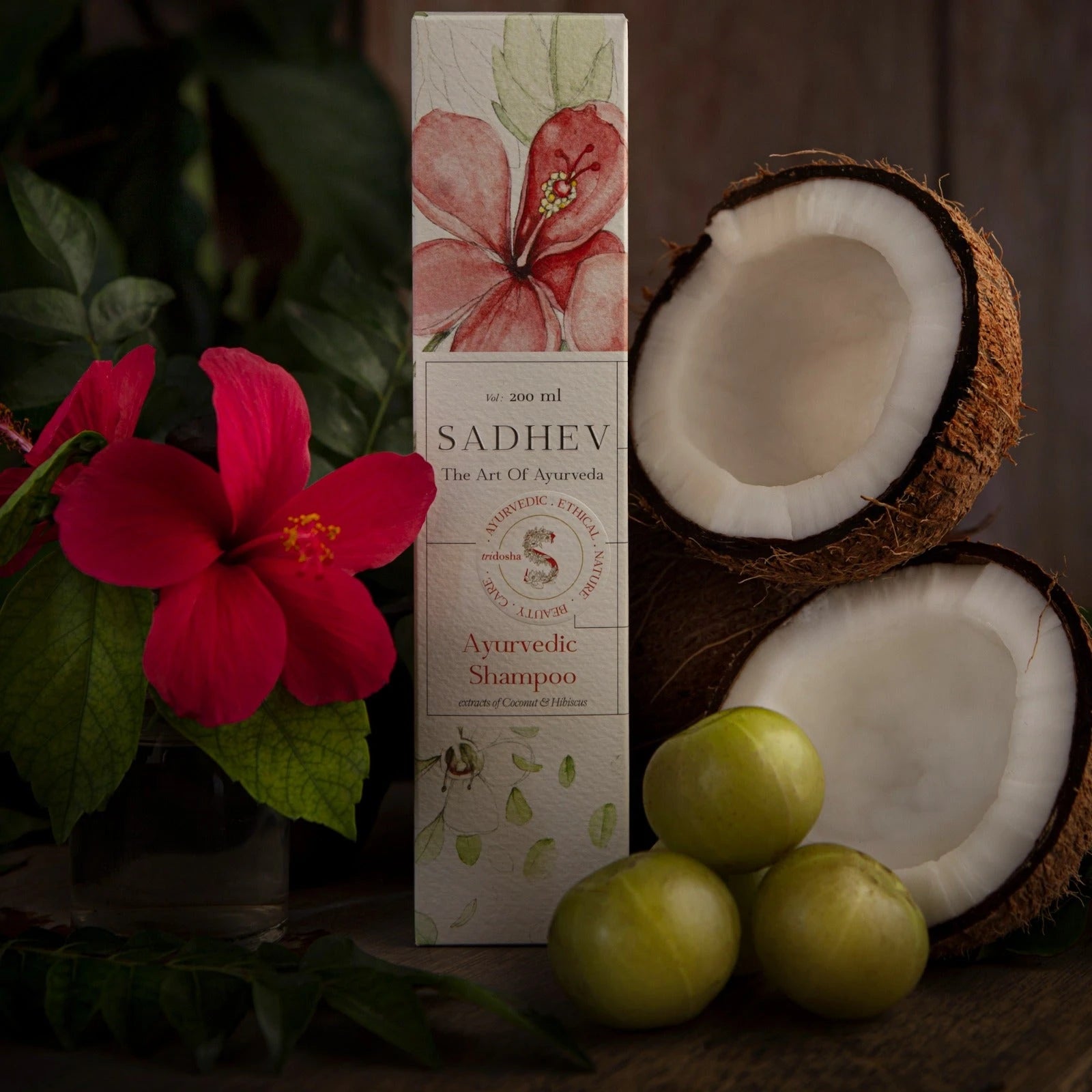
In SADHEV’s Ayurvedic Shampoo, amla is combined with bhringraj, hibiscus, curry leaves and reetha. Each ingredient supports a different aspect of scalp and hair health, and their combination in the classical formulation tradition produces a synergistic result that addresses hair fall, growth, conditioning and scalp balance in a single formulation. This is the formulation logic of a 200-year vaidyar lineage applied to a modern rinse-off format. The ingredients are classical. The delivery is contemporary. The result is both.
For the complete Ayurvedic skincare routine that incorporates amla-based Vitamin C treatment, see our skincare routine guide. For the Ayurvedic hair care routine built around bhringraj and amla, see our hair care routine guide.
SADHEV. Luxury Ayurvedic Care. Ayurveda in our bloodline.
Experience amla the way Ayurveda intended — in classical formulations rooted in a 200-year vaidyar lineage.
— Written by SADHEV Ayurvedic Experts, rooted in a 200-year vaidyar lineage.


