




Saffron is the most expensive spice in the world by weight. A kilogram requires the hand-harvesting of approximately 150,000 flowers, each yielding only three stigmas, in a window of a few weeks each year. The labour involved is extraordinary. The result is an ingredient that Ayurveda has recognised as one of its most potent skin treatments for thousands of years — and that modern cosmetic science has now spent considerable effort trying to understand and replicate.
The replication has been only partially successful. And the reason speaks directly to why source and handling matter as much as the ingredient itself.
SADHEV uses saffron from Pulwama in Kashmir — one of the world’s most prized saffron-growing regions — processed within 24 hours of harvest. Understanding why that specificity matters requires understanding what saffron actually is and what it does.
|
“Saffron is classified in classical Ayurveda under varnya gana — the category of herbs whose primary action is to give the skin a natural, luminous glow. It is not a supporting ingredient. It is the lead.” |
What Saffron Is — The Ayurvedic Classification
In classical Ayurveda, saffron — known as Kumkuma or Kesar — belongs to a category of herbs called varnya gana. Varnya translates roughly as that which gives the complexion its natural radiance. These are herbs whose primary documented action is on skin luminosity, tone and clarity.
This is not a modern marketing reframe of an ancient ingredient. The varnya gana classification appears in the Charaka Samhita and Sushruta Samhita — the foundational texts of classical Ayurveda written thousands of years ago. Saffron’s inclusion in this category reflects millennia of observation by vaidyars who documented its effects on skin with the same rigour they applied to every other therapeutic ingredient they worked with.
The active compounds responsible for saffron’s skin properties are primarily crocins and crocetin — the carotenoid pigments that give saffron its distinctive deep red-orange colour — along with safranal and picrocrocin. Together these compounds deliver the brightening, anti-inflammatory and antioxidant actions that make saffron one of the most valued ingredients in Ayurvedic skin formulation.
What Saffron Does for Skin — The Specific Actions
Saffron’s documented effects on skin fall into five distinct categories, each relevant to a different aspect of skin health.
Brightening and Complexion Enhancement
The crocins in saffron inhibit the activity of tyrosinase — the enzyme responsible for melanin production in the skin. By moderating this activity, saffron progressively reduces the appearance of dark spots, hyperpigmentation and uneven skin tone without the harsh bleaching action of chemical brighteners. The result is not a lightened complexion but a more even, luminous one — the natural radiance that Ayurveda describes as the skin returning to its own best state.
This is why saffron has been used in classical Ayurveda for centuries as a treatment for skin discolouration, sun damage and post-inflammatory pigmentation. The action is gentle, cumulative and does not compromise the skin’s natural tone in the process.
Anti-Inflammatory and Soothing
Saffron contains significant anti-inflammatory compounds including safranal and crocin, which reduce redness, calm reactive skin and support recovery from inflammation-related skin conditions including acne, rosacea and sensitivity. In classical Ayurvedic formulations, saffron is frequently combined with cooling ingredients like sandalwood and vetiver precisely because its anti-inflammatory action is amplified by these pairings — a formulation logic that SADHEV’s Kumkumadi Tailam follows directly.
Antioxidant Protection
The carotenoids in saffron are potent antioxidants that protect skin cells from oxidative damage caused by UV exposure, pollution and environmental stress. Oxidative damage is one of the primary drivers of premature ageing — the breakdown of collagen and elastin that leads to fine lines, loss of firmness and dullness. By neutralising free radicals before they can cause this damage, saffron provides a preventive benefit that complements its brightening and soothing actions.
Hydration and Nourishment
Saffron’s compounds support the skin’s natural moisture retention mechanisms, helping it maintain hydration without the heaviness of occlusives. In Ayurvedic formulations, saffron is typically used in a base of aloe vera or in an oil medium — both of which amplify its hydrating properties. The combination produces a level of skin nourishment that neither ingredient achieves as effectively alone.
Cellular Repair and Renewal
Classical Ayurvedic texts document saffron’s role in supporting the skin’s natural renewal process — the turnover of dead skin cells and the generation of healthy new ones. Modern research has identified specific mechanisms: saffron extracts stimulate certain cellular pathways associated with skin repair and have demonstrated protective effects on skin cell DNA in response to UV stress. The classical observation and the modern explanation point to the same outcome.
|
“Saffron does not change the skin. It restores it — returning it to the luminosity that is its natural state when properly nourished and protected.” |
Why Source and Handling Change Everything
Here is where the difference between genuinely effective saffron in a formulation and saffron as a label claim becomes critical.
Saffron’s active compounds — the crocins, crocetin, safranal and picrocrocin that deliver its therapeutic properties — are highly volatile. They begin to degrade immediately after the stigmas are separated from the flower. The rate of degradation depends on exposure to light, heat, moisture and time. Saffron processed within hours of harvest has a dramatically higher concentration of active compounds than saffron processed days later.
This is not a marginal difference. Studies on saffron quality have shown that crocin content — the primary marker of saffron potency — can decline by a significant percentage within 48 hours of harvest under suboptimal handling conditions. The saffron in a formulation processed a week after harvest may carry the name and the colour of the ingredient but a fraction of its therapeutic action.
Most brands that use saffron in their formulations source it from commodity suppliers. The supply chain between harvest and formulation involves multiple handling stages, storage periods and temperature variations. By the time the ingredient reaches the formula, its potency cannot be guaranteed.
SADHEV sources saffron from Pulwama in Kashmir and processes it within 24 hours of harvest. This is a specific, non-negotiable commitment that exists because the 200-year vaidyar lineage behind SADHEV’s formulations has always understood that the potency of an ingredient at the moment it enters the formula determines the potency of the formula itself. This is classical Ayurvedic sourcing logic applied with modern precision.
Pulwama — Why the Origin Matters
Saffron grown in different regions produces different chemical profiles. The soil composition, altitude, climate and farming practices of a growing region influence the concentration of active compounds in the stigmas. Pulwama in the Kashmir valley is recognised as producing some of the world’s highest-quality saffron — a reputation built over centuries of cultivation in conditions that are uniquely suited to producing stigmas with high crocin and safranal concentrations.
Choosing Pulwama saffron is not a marketing decision. It is a formulation decision based on the same sourcing logic that governs every ingredient SADHEV uses — the best version of the ingredient, from its true place of origin, at its peak potency.
Saffron in SADHEV Formulations
Saffron appears in two of SADHEV’s bestselling formulations, in different roles that reflect the classical Ayurvedic understanding of how to deploy the ingredient most effectively.
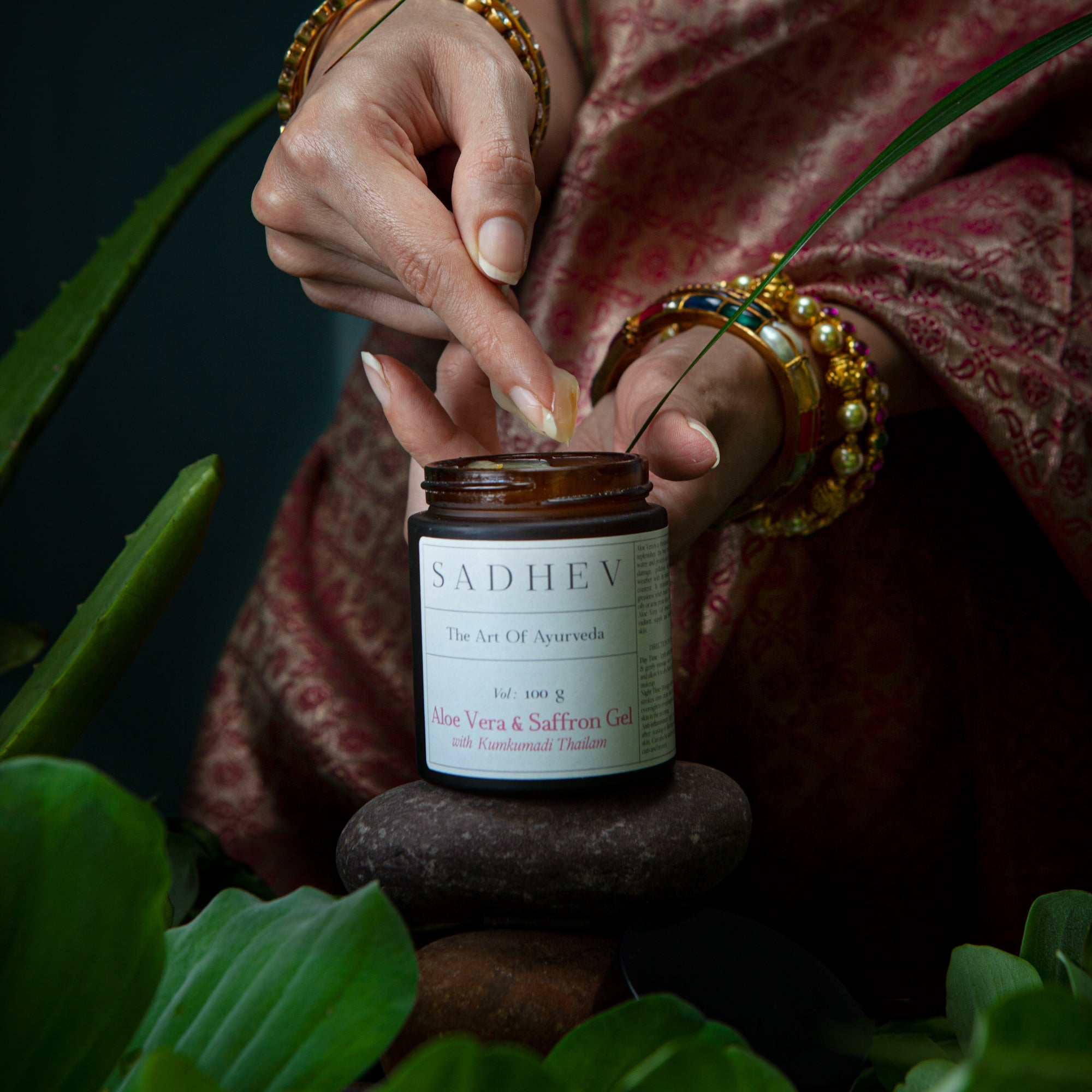
In the Aloe Vera & Saffron Gel with Kumkumadi Tailam, saffron works in an aloe vera base — a classical pairing that amplifies both the brightening action of the saffron and the hydrating action of the aloe. The gel texture makes it suitable for daily use as a moisturiser and the saffron concentration is sufficient to produce visible brightening effects with consistent use over several weeks.
In Kumkumadi Tailam, saffron is the primary active in a classical oil-based formulation that follows the traditional tailam preparation method. The oil medium extracts the fat-soluble components of saffron with a completeness that a water-based formulation cannot match, and the slow preparation process ensures full transfer of the active compounds into the base. This is the most potent delivery of saffron’s therapeutic properties available in SADHEV’s range.
Both formulations use Pulwama saffron processed within 24 hours. Both carry the 200-year vaidyar formulation logic that determines how saffron is combined with the other ingredients it works best alongside.
|
“The 24-hour harvest window is not a detail. It is the difference between a saffron formulation and a saffron-labelled formulation.” |
How to Get the Most from Saffron in Skincare
Saffron’s benefits are cumulative. Unlike some active ingredients that produce immediate visible results, saffron’s brightening and repair actions develop progressively with consistent use over four to eight weeks. This is consistent with its classical Ayurvedic characterisation as a restorative ingredient rather than a corrective one.
For best results, use a saffron-based formulation as part of a consistent daily routine rather than intermittently. Apply on clean, toned skin so the active compounds can penetrate without the barrier of accumulated impurities. In the morning, follow with sunscreen — saffron’s antioxidant action is most valuable when paired with UV protection that prevents the oxidative damage it is working to repair.
At night, saffron in an oil base — such as Kumkumadi Tailam — works most effectively because the skin’s repair cycle during sleep amplifies the ingredient’s cellular renewal action. This is the classical Ayurvedic rationale for the tailam as a night treatment and it remains as valid today as it was when the formulation was first documented.
For the complete morning and evening Ayurvedic skincare routine built around saffron-based formulations, see our full skincare routine guide
SADHEV. Luxury Ayurvedic Care. Ayurveda in our bloodline.
Experience saffron the way Ayurveda intended — from Pulwama, processed within 24 hours, in a 200-year vaidyar formulation.
— Written by SADHEV Ayurvedic Experts, rooted in a 200-year vaidyar lineage.


