





The skincare aisle has never been more crowded. Cleansers, toners, essences, serums, moisturisers, face oils, sunscreens, exfoliants, masks — the number of steps a routine can involve has expanded to the point where most people feel overwhelmed before they have even begun.
Ayurveda has a different starting point. Rather than layering as many actives as possible onto the skin, the classical approach asks a simpler question: what does this skin actually need, and in what order should it receive it?
The answer, developed over thousands of years of observation and refined through generations of vaidyar practice, is a routine that is far more straightforward than the modern beauty industry would have you believe. And when the products within that routine are genuinely Ayurvedic — formulated from a lineage rather than from a trend — the results are consistent in a way that product-hopping never achieves.
Here is how to build one that actually works.
|
“Ayurveda does not ask you to do more. It asks you to do the right things — in the right order, with the right ingredients.” |
Before the Steps: Understanding the Ayurvedic Approach to Skin
Classical Ayurveda understands skin not as a surface to be treated but as a reflection of the body’s internal state. The skin’s condition — its oiliness, dryness, sensitivity, tendency to break out or age quickly — is an expression of the balance or imbalance of the three doshas: Vata, Pitta and Kapha.
Vata skin tends to be dry, thin and prone to early signs of ageing. It benefits from deep nourishment and hydration. Pitta skin tends to be sensitive, prone to redness and reactive to heat and stress. It benefits from cooling, soothing ingredients. Kapha skin tends to be oily, thick and prone to congestion. It benefits from gentle cleansing and lightening formulations.
You do not need to know your dosha type to follow an Ayurvedic routine. What matters is understanding that the goal is not to suppress what your skin is doing but to support it — giving it what it needs to return to its natural balance rather than forcing it into a temporary state through aggressive actives.
With that principle in place, here is the routine.
The Morning Routine
|
Step 2 — Tone — Balance and Prepare |
|
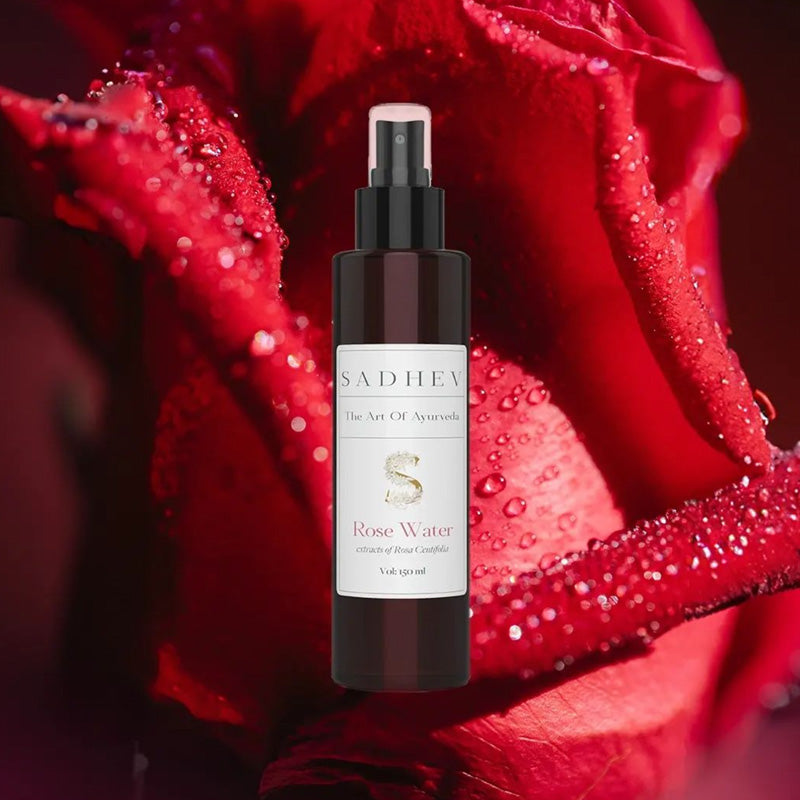
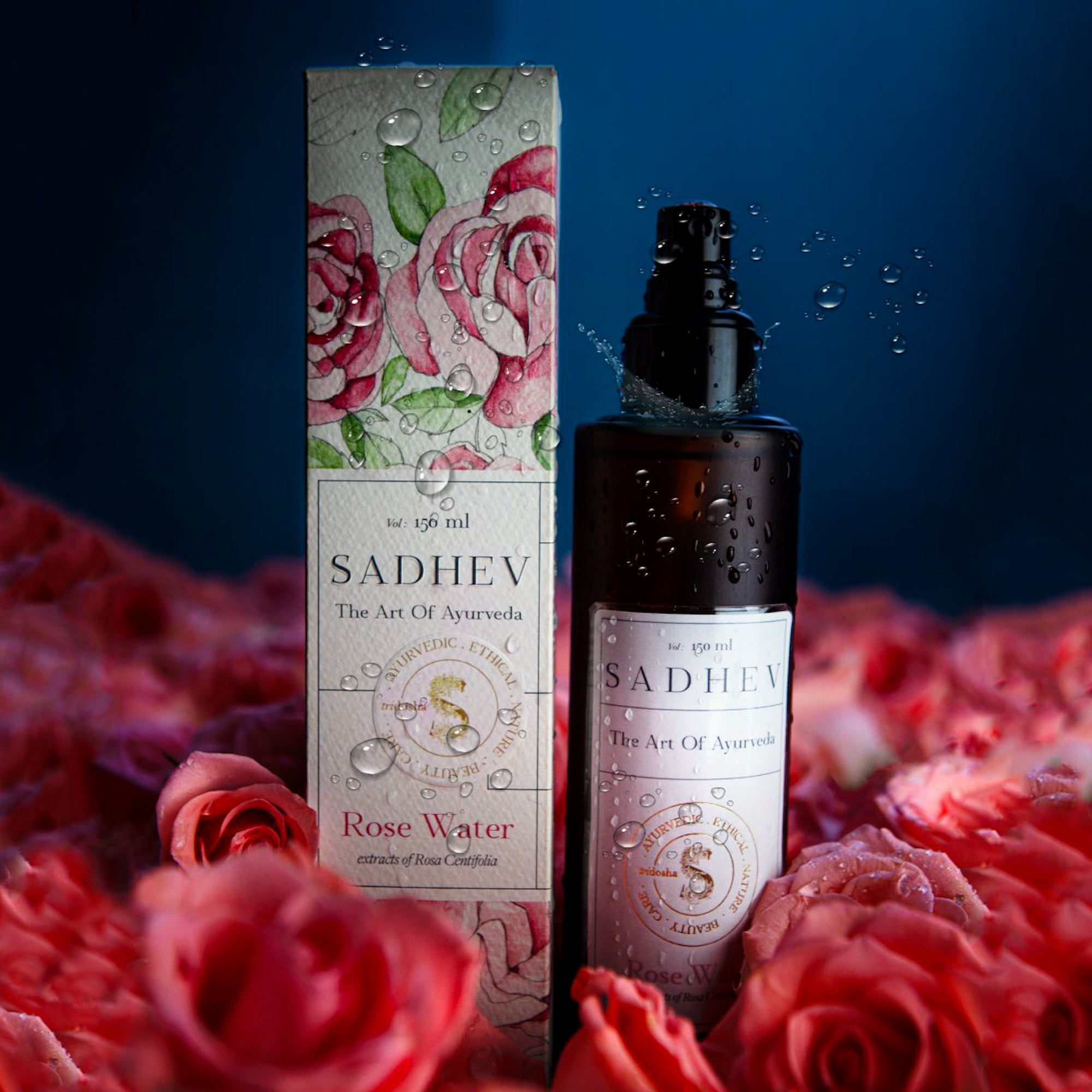
Toning is one of the most underused steps in modern skincare and one of the most important in classical Ayurveda. A toner restores the skin’s pH after cleansing, tightens pores, removes any remaining residue and — critically — prepares the skin to absorb everything that follows more effectively. Rose water is the classical Ayurvedic toner. Steam-distilled from Centifolia roses, it is naturally astringent, anti-inflammatory and hydrating. It works on all skin types and has no equivalent in synthetic toners. Apply with clean hands or a cotton pad after cleansing and allow it to settle before moving to the next step. |
|
This is where a serum or treatment product is applied. In the morning routine, the treatment step targets the concerns most relevant to your skin — brightening, pigmentation, dullness — using ingredients that are light enough to layer under a moisturiser and sunscreen. SADHEV’s Vitamin C Serum, formulated with amla and Kakadu plum, is the morning treatment of choice for most skin types. Applied on toned skin, it addresses uneven tone and provides antioxidant protection before daily UV exposure. For those with specific brightening concerns, 2 to 3 drops applied to the face and neck is sufficient. |
|
Step 4 — Moisturise — Seal and Nourish |
|
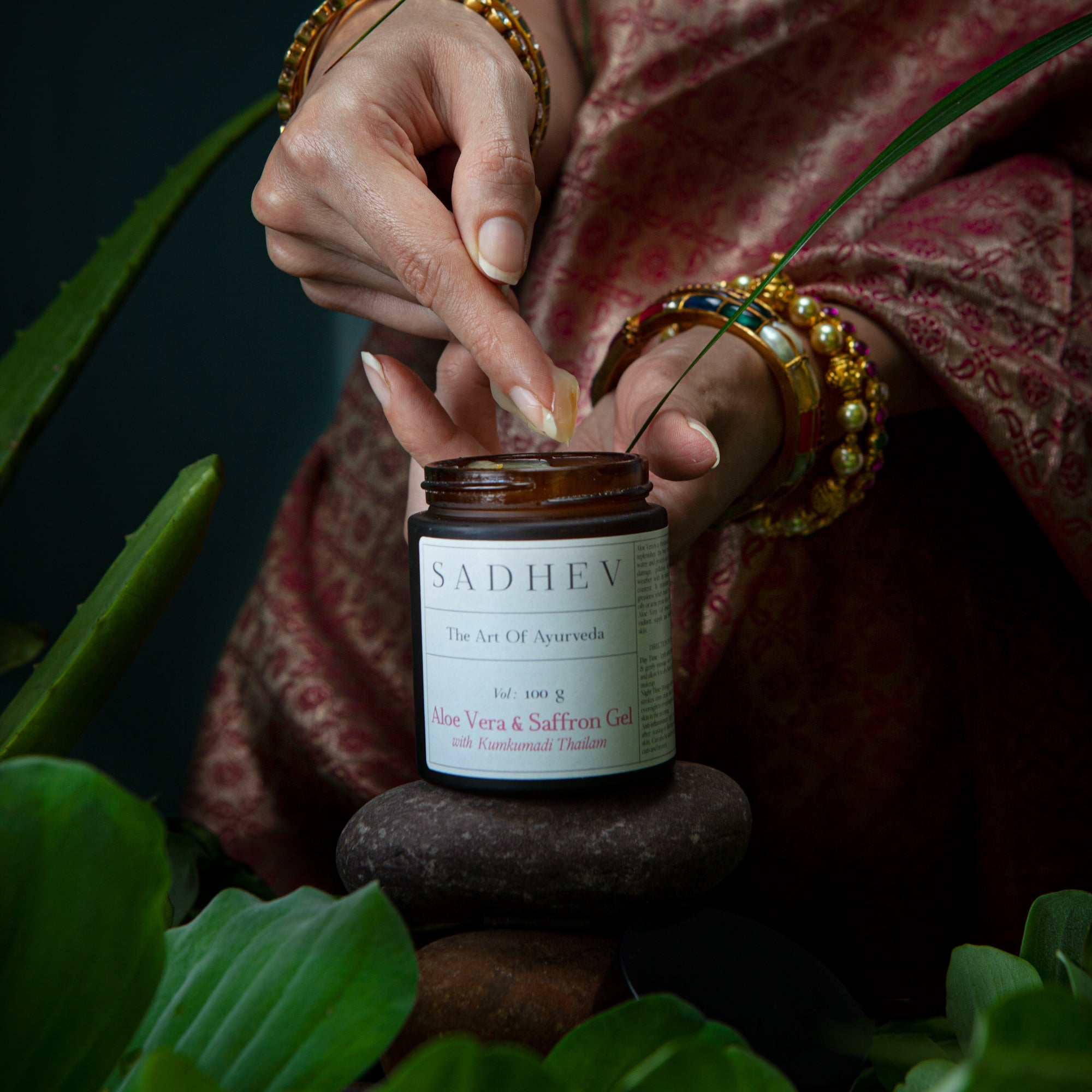
Ayurveda has always understood that hydrated skin is healthy skin. The morning moisturiser should be lightweight enough to wear under sunscreen and suited to your skin type — neither too heavy for oily skin nor too light for dry skin. SADHEV’s Aloe Vera & Saffron Gel with Kumkumadi Tailam is the most versatile morning moisturiser in the range — a gel texture that absorbs quickly without heaviness, providing hydration, saffron-driven brightness and the nourishing properties of kumkumadi tailam in a single step. Apply a small amount to the face and neck after your serum has absorbed. |
|
Step 5 — Protect — Sunscreen, Every Morning |
|
This step is non-negotiable in Ayurveda as in dermatology. UV damage is the single largest driver of premature ageing, pigmentation and skin stress. Applying sunscreen every morning — regardless of whether you are stepping outside — is the most effective anti-ageing action available. Choose a mineral-based, broad-spectrum sunscreen with at least SPF 30. SADHEV’s Sunscreen Gel SPF 50 PA+++ is formulated with zinc oxide, moringa and liquorice — a lightweight gel that absorbs without white cast or greasiness, suitable for all skin types. Apply as the final step of your morning routine. |
The Evening Routine
The evening routine is where the deeper work happens. Skin is in repair mode through the night. The evening is when richer, more potent formulations can be applied without the interference of UV exposure, and when the skin is most receptive to nourishment.
|
The evening cleanse is more thorough than the morning one. After a full day of sunscreen, pollution, sebum and environmental exposure, the skin needs a proper reset. Ayurveda recommends a two-step approach: an oil-based first cleanse to dissolve sunscreen and impurities, followed by a water-based cleanser to complete the cleanse. If you have used an oil-based makeup or a heavy sunscreen, a gentle cleansing oil as the first step dissolves these without requiring aggressive rubbing. Follow with your regular botanical cleanser to finish. If your sunscreen is lightweight and gel-based, a single thorough cleanse is sufficient. |
|
Rose water after the evening cleanse serves the same function as in the morning — restoring pH, tightening pores and preparing skin for what follows. The difference is that in the evening, what follows is richer and more nourishing, so this preparation step is if anything more important. Apply rose water generously to freshly cleansed skin and allow it to absorb before proceeding. In Ayurvedic practice, applying the next step while the skin is still slightly damp from the toner helps deeper absorption. |
|
Step 3 — Target — Under Eye Care |
|
The skin under the eyes is the thinnest and most delicate on the face. It has no oil glands, dehydrates faster than the rest of the face and shows signs of fatigue, ageing and stress earlier than anywhere else. It requires its own dedicated treatment. Apply SADHEV’s Under Eye Gel — formulated with cucumber, liquorice, rose and aloe vera — to the under-eye area using your ring finger in gentle tapping motions. Do not rub. Allow it to absorb fully before the next step. This is best applied before the face oil so the lighter gel can penetrate unimpeded. |
|
Step 4 — Restore — The Night Treatment |
|
This is the most important step of the evening routine. A classical Ayurvedic face oil applied at night works with the skin’s natural nocturnal repair cycle — penetrating deeply while the skin is at rest, delivering therapeutic ingredients where they can be most effective. SADHEV’s Kumkumadi Tailam is formulated for exactly this purpose. Apply 3 to 5 drops to clean, toned skin after the under eye gel has absorbed. Press gently into the skin using upward strokes rather than rubbing. The saffron, sandalwood, vetiver and classical base oils work through the night to brighten, nourish and restore. Wake up to skin that feels genuinely different. |
The Weekly Additions
A complete Ayurvedic routine also includes two occasional practices that deepen the effect of the daily steps.
Exfoliation once or twice a week removes dead skin cells that accumulate on the surface and prevent your daily products from penetrating effectively. Use a gentle Ayurvedic face scrub with natural exfoliants — sugarcane, apple, lemon — that work without micro-tears or over-stripping.
A face mask once a week allows more concentrated ingredients to sit on the skin for an extended period, providing benefits that a rinse-off cleanser or a leave-on serum cannot achieve in the same way. Ayurvedic masks using clay, turmeric, sandalwood and botanical powders have been used for this purpose for thousands of years.
|
“Consistency beats complexity. A six-step routine followed every day will outperform a twelve-step routine followed occasionally.” |
The Principle Behind the Routine
What distinguishes an Ayurvedic skincare routine from a collection of natural products used in sequence is the underlying logic. Each step prepares the skin for the next. Each product is chosen not just for what it contains but for what it does in context — how it interacts with what came before and what comes after.
This is the formulation intelligence that a 200-year vaidyar lineage brings to SADHEV products. The rose water is not just a toner. It is the preparation that makes the serum more effective. The Kumkumadi Tailam is not just a face oil. It is the classical night treatment that works with skin’s biology rather than against it.
Build the routine. Follow it consistently. Give it six weeks. Ayurveda does not promise overnight results — it promises lasting ones.
SADHEV. Luxury Ayurvedic Care. Ayurveda in our bloodline.
Shop the complete SADHEV Ayurvedic skincare routine.
— Written by SADHEV Ayurvedic Experts, rooted in a 200-year vaidyar lineage


