




The hibiscus flower is one of the most visually recognisable plants in the Indian subcontinent. It grows abundantly, blooms in vivid red and pink, and has been a fixture of temple offerings, festive rituals and household gardens for as long as Indian cultural memory extends.
It has also been a fixture of classical Ayurvedic hair care formulation for thousands of years. Known in Sanskrit as Japakusum, hibiscus appears in Ayurvedic texts with a specificity of documentation that reflects not passing reference but deep, consistent clinical use by generations of vaidyars who observed its effects on hair and scalp health across different patients, different conditions and different seasons.
Modern research has spent the last few decades catching up with what those vaidyars documented. The mechanisms are now partially understood. The outcomes they described have been validated. And the ingredient that Ayurveda identified as one of its most effective for hair growth and hair fall has found its way into some of the most evidence-backed natural hair care formulations available.
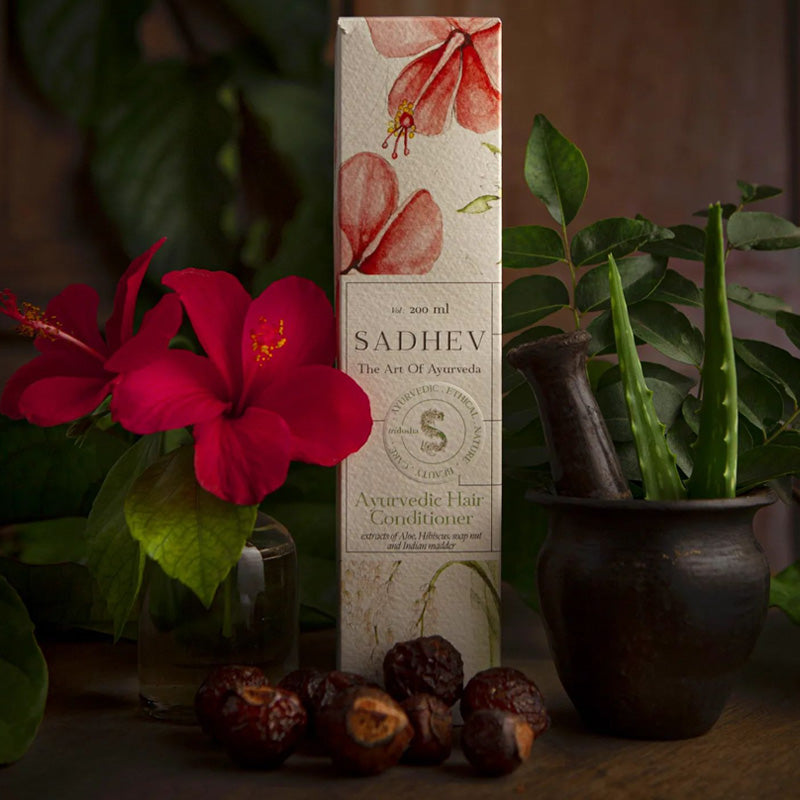
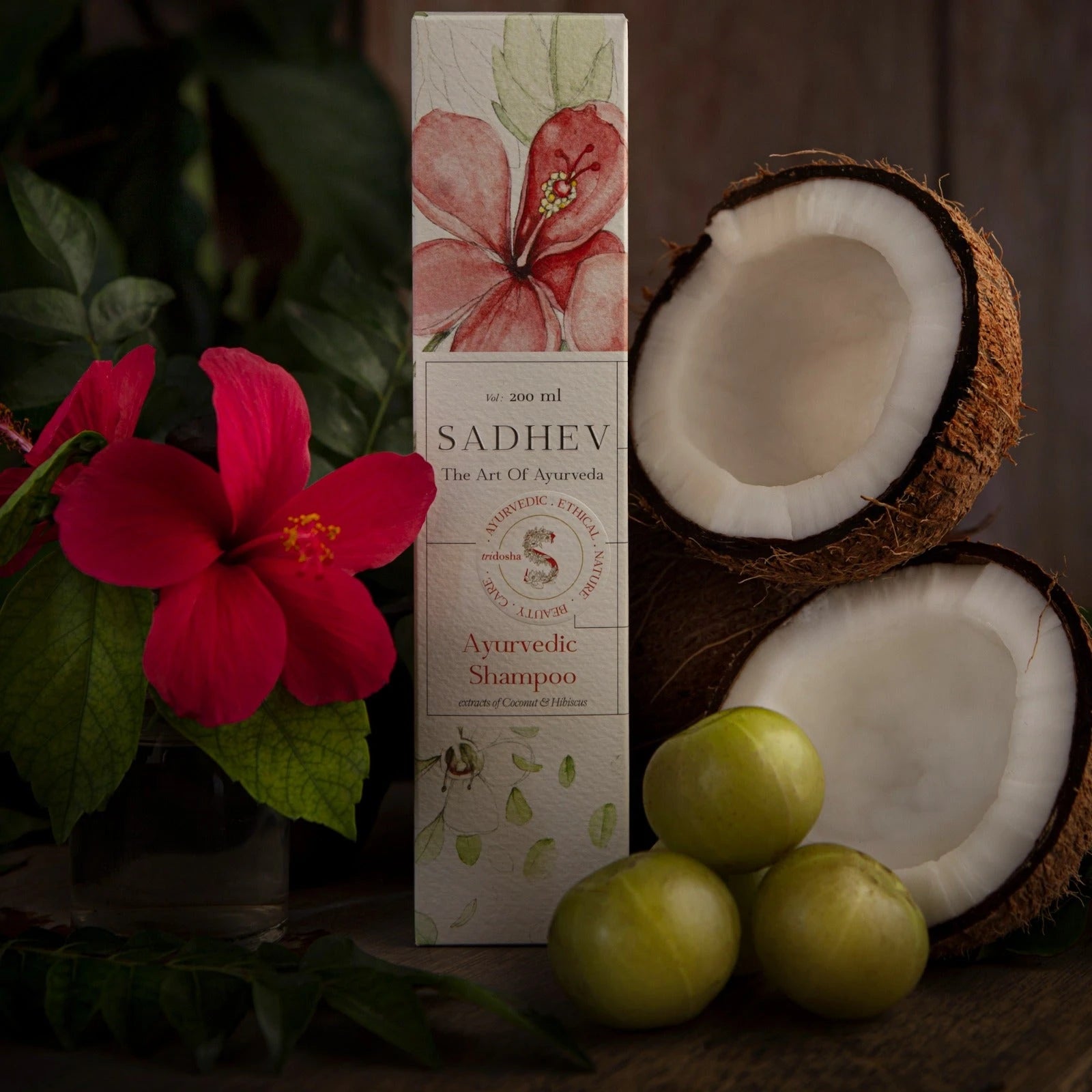
SADHEV’s Ayurvedic Shampoo and Hair Conditioner both feature hibiscus as a primary active. Here is what it does and why it belongs there.
|
“Japakusum — hibiscus — has been documented in classical Ayurveda as Keshya for thousands of years. The title means beneficial to hair. It is one of the most consistently used herbs in the classical hair care pharmacopoeia.” |
What Hibiscus Is — The Ayurvedic Classification
Hibiscus rosa-sinensis — the Chinese hibiscus or shoe flower — is the variety most widely used in Ayurvedic hair care formulation, though several species have been documented in classical texts. The flowers, leaves and roots all have distinct therapeutic applications, but it is the flower and leaf that carry the properties most relevant to hair and scalp health.
In classical Ayurvedic classification, hibiscus is described as Keshya — beneficial to hair — and Keshvardhana — that which promotes hair growth. These are not general descriptors. They are specific therapeutic categories used in the classical pharmacopoeia to identify herbs whose primary documented action is on hair health. Hibiscus’s inclusion in both categories reflects the consistency and reliability of its observed effects across generations of vaidyar practice.
Its primary therapeutic qualities in the classical system are described as cooling, soothing and nourishing — actions that make it particularly relevant for Pitta-type hair concerns, which include hair fall driven by heat, inflammation and stress, and premature greying driven by oxidative damage to the hair follicle.
What Hibiscus Does for Hair — The Specific Actions
Stimulates Hair Growth
Hibiscus is one of the most studied natural ingredients for hair growth stimulation. The compounds in hibiscus flowers and leaves — particularly hibiscifolic acid, hibiscetin and a range of polyphenols — have been shown to stimulate the proliferation of dermal papilla cells. The dermal papilla is the structure at the base of each hair follicle that drives hair growth — when its cells divide actively, the follicle produces hair. When dermal papilla activity declines, hair growth slows and thins.
Research comparing hibiscus extract with conventional hair growth treatments has shown statistically significant increases in dermal papilla cell proliferation, with effects in some studies comparable to well-known pharmaceutical hair growth actives. The classical Ayurvedic designation of hibiscus as Keshvardhana — that which promotes hair growth — reflects precisely this action, observed and documented thousands of years before the cellular mechanism was understood.
Reduces Hair Fall
Hibiscus addresses hair fall through multiple complementary mechanisms. Its Vitamin C content — significant in both the flowers and leaves — supports collagen synthesis in the scalp, strengthening the follicular structure that anchors each hair. Its anti-inflammatory compounds reduce scalp inflammation, which is one of the most common but least recognised drivers of increased shedding. And its natural conditioning properties reduce mechanical hair fall caused by breakage during washing, brushing and styling.
The combination of follicular strengthening, scalp inflammation reduction and mechanical protection makes hibiscus one of the most comprehensive natural remedies for hair fall available in the Ayurvedic pharmacopoeia. This is why it appears consistently in classical hair fall formulations alongside bhringraj and amla — the three ingredients address hair fall through different but complementary mechanisms, and their combination produces a more comprehensive result than any one alone.
Our Ayurvedic hair care routine guide covers how to use hibiscus-formulated products within a complete routine for maximum hair fall reduction.
Conditions and Softens Hair
Hibiscus contains natural mucilage — a gel-like substance that coats the hair shaft when applied in a rinse-off formulation. This coating smooths the hair cuticle, reduces friction between hairs, detangles effectively and leaves hair noticeably softer and more manageable after washing. The conditioning effect is immediate and visible from the first use.
This natural conditioning action is why hibiscus has been used in classical Ayurveda not just as a hair fall treatment but as a hair care ingredient in the broadest sense — it addresses both the therapeutic concern of hair fall and the cosmetic concern of manageability and texture simultaneously. In SADHEV’s formulations, this dual action is preserved in a sulphate-free base that cleanses and conditions without the stripping that conventional shampoos produce.
Prevents Dryness and Nourishes the Scalp
Hibiscus has significant emollient properties that nourish both the scalp and the hair shaft. Its natural amino acids penetrate the hair cortex, providing structural support from within rather than simply coating the outside. This internal nourishment improves hair strength, reduces brittleness and makes hair more resistant to the physical damage of daily styling, environmental exposure and heat.
For dry scalp conditions — which in Ayurveda are associated with Vata imbalance — hibiscus provides the deep, soothing moisture that the scalp needs to support healthy follicle function. A dry, depleted scalp is an inhospitable environment for hair growth. Hibiscus, with its combination of moisture delivery, anti-inflammatory action and follicular stimulation, addresses this condition comprehensively.
Supports Natural Hair Colour
Classical Ayurvedic texts document hibiscus as one of the herbs used in formulations to support natural hair pigmentation and delay premature greying. The mechanism, as with bhringraj and amla, involves the protection of melanocytes — the pigment-producing cells in the hair follicle — from oxidative damage. Hibiscus’s polyphenol content provides antioxidant protection that helps maintain melanocyte activity and the natural colour production that depends on it.
Long-term consistent use of hibiscus-based formulations is associated in classical Ayurvedic practice with the preservation of natural hair colour. This is a cumulative benefit that develops over months of use rather than weeks.
Balances Scalp Oil Production
Hibiscus has a mild astringent action that helps regulate sebum production on the scalp. For oily scalp conditions — associated with Kapha imbalance in classical Ayurveda — hibiscus helps normalise oil levels without stripping or drying. The result is a scalp that feels cleaner for longer between washes and is less prone to the buildup that contributes to dandruff and follicle congestion.
This oil-balancing action, combined with hibiscus’s simultaneous moisturising properties, makes it one of the rare hair care ingredients that is equally beneficial for oily scalp and dry hair — a combination that is more common than most people realise and that conventional shampoos address poorly.
|
“Hibiscus does not address one hair concern. It addresses several simultaneously — growth stimulation, fall reduction, conditioning, scalp balance, colour preservation — through mechanisms that classical Ayurveda documented and modern research has begun to validate.” |
Hibiscus in SADHEV Formulations
Hibiscus is a primary active in both SADHEV’s Ayurvedic Shampoo and Hair Conditioner, where it works alongside bhringraj, amla, curry leaves and reetha in a formulation logic that follows classical Ayurvedic combinatorial principles.
Each ingredient in the combination addresses a different dimension of hair and scalp health. Bhringraj stimulates the scalp and extends the growth cycle. Amla strengthens follicles and supports natural colour. Hibiscus conditions, reduces hair fall through multiple pathways and stimulates dermal papilla cell activity. Curry leaves nourish the follicle and support density. Reetha cleanses gently without sulphates. The combination is a classical Ayurvedic hair care formulation in a contemporary rinse-off format.
The sulphate-free base is not incidental to this formulation. Hibiscus’s conditioning and follicular stimulation effects require a scalp environment that has not been disrupted by harsh detergents. A sulphate-based shampoo containing hibiscus would partially counteract the ingredient’s benefits with every wash. SADHEV’s formulation ensures that the cleansing action and the therapeutic action are aligned throughout the entire product.
SADHEV’s Ayurvedic Shampoo and SADHEV’s Ayurvedic Hair Conditioner together deliver the full hibiscus benefit in the correct sequence — the shampoo cleanses and begins the therapeutic action, the conditioner seals the cuticle and extends the conditioning and nourishment benefit through until the next wash.
How Long Before You See Results
Hibiscus’s effects on hair growth and hair fall, like those of bhringraj and amla, are cumulative. Visible changes in hair density and shedding levels develop over eight to twelve weeks of consistent daily use. The conditioning and softening effects are immediate from the first wash. The therapeutic effects on the follicle and scalp require time to accumulate.
This expectation is consistent with classical Ayurvedic guidance on hair care formulations. The classical texts prescribe sustained, consistent use over months rather than weeks. The immediate cosmetic result — softer, shinier, more manageable hair — is visible from the first wash. The therapeutic result — less shedding, improved density, healthier scalp — builds progressively and compounds with time.
For the complete step-by-step protocol for using hibiscus-formulated products as part of an Ayurvedic hair care routine, including the oil, cleanse, condition and treat sequence, see our Ayurvedic hair care routine guide.
Hibiscus, Bhringraj and Amla — The Classical Trio
One of the defining characteristics of classical Ayurvedic formulation is the use of ingredient combinations whose actions complement and reinforce each other. Hibiscus, bhringraj and amla represent one of the most well-established combinations in the classical hair care pharmacopoeia — three herbs whose individual actions on hair fall, growth, conditioning and scalp health are comprehensive when used together.
SADHEV’s hair care formulations are built on this combination. For a detailed understanding of how bhringraj contributes to this formulation logic, see our bhringraj ingredient guide. For the role of amla in hair and scalp health, see our amla ingredient guide.
SADHEV. Luxury Ayurvedic Care. Ayurveda in our bloodline.
Experience hibiscus the way Ayurveda intended — in a sulphate-free formula built on 200 years of vaidyar knowledge. Shop SADHEV Ayurvedic Shampoo, explore the SADHEV Ayurvedic Hair Conditioner, or browse the full SADHEV hair care range.
— Written by SADHEV Ayurvedic Experts, rooted in a 200-year vaidyar lineage.


